
UAE E-Invoicing 2026: Deadlines and Business Readiness Guide
Introduction
Author: Vipul Gupta, Director, GetMyAccounting | Last updated: 17 July 2026
Official source note: The UAE Ministry of Finance eInvoicing portal should be treated as the primary official source for UAE e-invoicing updates, guidelines, approved service-provider information and future changes. Timelines, provider lists, technical documents and implementation rules should be rechecked against the MoF portal before publishing or updating this blog.
Quick Answer: UAE e-invoicing will require in-scope business invoices to be issued, exchanged and reported as structured electronic data through an Accredited Service Provider. Mandatory implementation begins in phases from 1 January 2027, while voluntary implementation has been available from 1 July 2026.
E-invoicing is becoming a major compliance and accounting change for UAE businesses. Many companies still create invoices in accounting software, save them as PDF files and send them by email. Under the UAE e-invoicing framework, the focus moves from a document that simply looks digital to structured invoice data that systems can validate, exchange and report electronically.
This guide explains the current UAE e-invoicing deadlines, who may be in scope, how the Accredited Service Provider model works, what penalties businesses should know and what accounting records should be reviewed before technical onboarding begins.
GetMyAccounting note: This is an informational awareness guide. GetMyAccounting currently supports UAE businesses with accounting, bookkeeping, VAT, Corporate Tax and financial-record readiness. It should not be represented as an Accredited Service Provider or e-invoicing software company unless it becomes officially approved and listed by the UAE Ministry of Finance.
What Is E-Invoicing in the UAE?
Quick Answer: An eInvoice is structured invoice data issued and exchanged electronically between a supplier and buyer and reported electronically to the Federal Tax Authority.
A proper eInvoice is designed for automatic and electronic processing. It is not simply a normal invoice saved in digital form. The UAE framework uses structured, machine-readable invoice information and Accredited Service Providers to exchange invoice data and report required tax information.
Is a PDF Invoice an eInvoice?
Quick Answer: No. PDF, Word, image, scanned-copy and email formats are not structured eInvoices.
A PDF invoice may remain useful for human viewing, but it does not by itself meet the structured electronic-data requirement. The underlying data should be complete and consistent, including supplier and buyer details, TIN or TRN information, invoice number, invoice date, taxable amount, VAT amount, item description and credit-note references.
Who Is Within the Scope of UAE E-Invoicing?
Quick Answer: The rules broadly apply to persons conducting business transactions in the UAE, regardless of VAT-registration status, unless a person or transaction is specifically excluded.
The scope is wider than VAT registration alone. A business may still need to consider e-invoicing even if it is not currently VAT registered. An in-scope person that is not registered for any UAE tax type may need to register with the Federal Tax Authority to obtain a Tax Identification Number for e-invoicing.
Transaction Current position Simple meaning B2B In scope Business sells to another business B2G In scope Business supplies a government entity G2B / G2G In scope Government-related business transactions B2C Not currently subject Supply to a consumer who is not carrying on businessSpecific exclusions also apply, including certain sovereign activities, certain airline supplies and specified exempt financial services. Businesses should check the latest Ministry of Finance guidance because exclusions may be amended or clarified in future official updates.
Do Free Zone Companies Need to Prepare?
Quick Answer: Yes. A free zone company is not automatically outside the e-invoicing framework simply because it operates from a free zone.
The business should review its transaction type, customer type, revenue category, tax identifiers, applicable exclusions and mandatory timeline. Free zone businesses should therefore start reviewing invoice records, customer and supplier data, TIN or TRN details and accounting-system readiness early.
UAE E-Invoicing Implementation Deadlines
Quick Answer: Mandatory implementation is phased according to annual revenue, with a separate timeline for government entities.
Entity category Last date to appoint an ASP Mandatory implementation Annual revenue AED 50 million or more 30 October 2026 1 January 2027 Annual revenue below AED 50 million 31 March 2027 1 July 2027 Government entity 31 March 2027 1 October 2027The original deadline for businesses with annual revenue of AED 50 million or more was amended. Ministerial Resolution No. 66 of 2026 changed their ASP-appointment deadline to 30 October 2026, while keeping the mandatory implementation date at 1 January 2027. Businesses should still confirm the latest official position on the Ministry of Finance portal before publishing or acting on deadlines.
Can a Business Implement E-Invoicing Voluntarily?
Quick Answer: Yes. Businesses of any revenue level may implement e-invoicing voluntarily from 1 July 2026, subject to the required technical rules.
Voluntary implementation can help a business test systems, internal workflows and ASP coordination before its mandatory date. However, the business still needs an appropriate Accredited Service Provider and must follow the prescribed technical requirements.
What Is an Accredited Service Provider?
Quick Answer: An Accredited Service Provider, or ASP, is a technology provider approved to support e-invoicing services under the UAE framework.
The ASP helps validate, convert, exchange and report structured invoice data. An accounting or tax firm is not automatically an ASP. A business should select a provider from the official UAE list and complete onboarding through the prescribed FTA and EmaraTax process.
Before selecting an ASP, businesses should compare integration method, data-security controls, pricing, support availability, contract terms, ERP/accounting-software compatibility, service-level commitments and onboarding timeline.
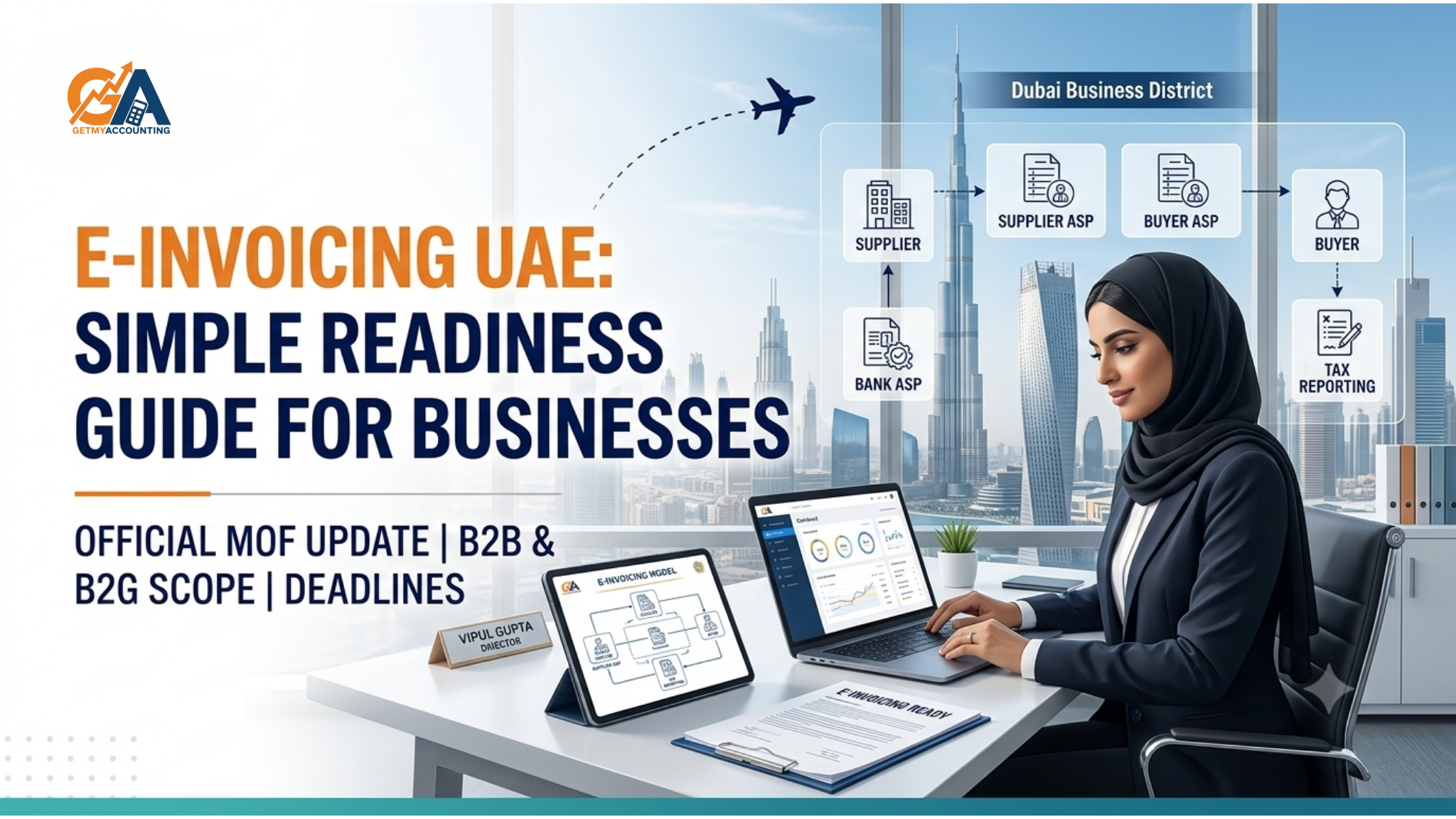
How the UAE E-Invoicing 4-Corner Process Works
Quick Answer: In a simple 4-corner model, the supplier and buyer exchange invoice data through their appointed Accredited Service Providers instead of sending only PDF invoices by email.
Step What happens 1 The supplier sends invoice data from its accounting, ERP or invoicing system to its appointed ASP. 2 The supplier ASP validates the data and converts it into the required UAE structured format where necessary. 3 The supplier ASP sends the eInvoice to the buyer ASP and reports the required tax data. 4 The buyer ASP validates the invoice and delivers it to the buyer. 5 Confirmation and status messages are exchanged so the supplier and buyer can track successful or failed processing.When Are Electronic Credit Notes Needed?
Quick Answer: An electronic credit note may be required when a transaction is cancelled, the agreed consideration is reduced, a full or partial refund is made, or an administrative or numerical error needs correction.
Businesses should not only review invoice creation. They should also review how credit notes, debit notes, cancellations and corrections are currently handled in their accounting system. If credit notes are not linked to the original invoice or if the reason for correction is unclear, e-invoicing implementation can become difficult.
What Should a UAE Business Prepare Now?
Quick Answer: Start with accounting data, invoice fields, customer and supplier records, tax identifiers, credit-note links, software settings and internal responsibility.
- Review whether invoices contain consistent supplier and customer details.
- Check TIN and TRN information and identify missing tax identifiers.
- Clean duplicate or inconsistent customer and supplier master records.
- Review VAT codes, taxable values, VAT amounts and item or service descriptions.
- Check invoice numbering, issue dates, credit notes, debit notes and cancellation processes.
- Confirm which accounting or ERP system generates invoices and how invoice data can be exported or integrated.
- Define who creates, reviews, approves, corrects and cancels invoices.
- Estimate invoice volumes and identify the types of B2B and B2G transactions carried out.
- Compare ASPs based on integration, pricing, security, support and contract terms.
What Is the TIN for UAE E-Invoicing?
Quick Answer: The Tax Identification Number is the participant identifier used for UAE e-invoicing. For an entity already registered with the FTA, the TIN is generally linked to its existing TRN information.
A person that is within the scope of e-invoicing but is not registered for any UAE tax type may need to register with the FTA to obtain a TIN. Businesses should not wait until ASP onboarding to discover that tax identifiers or legal details are incomplete.
Why Accounting-Software Readiness Matters
Quick Answer: Using Tally, Zoho Books, QuickBooks, Xero, Odoo, SAP or another system does not automatically make a business e-invoicing ready.
The business must check how invoice data is stored, whether customer and supplier records are complete, how VAT codes are applied, whether credit notes are linked correctly and how data will move between the existing system and the selected ASP. Some businesses may use direct integration, while others may use an approved connector, middleware or another supported method.
What Are the Main E-Invoicing Penalties?
Quick Answer: Penalties may apply when a business required to implement e-invoicing misses the implementation/ASP deadline, fails to issue or transmit eInvoices or e-credit notes, or fails to notify required parties about system/data issues.
Violation Administrative penalty Failure to implement the system or appoint an ASP by the prescribed deadline AED 5,000 for each month or part of a month of delay Failure to issue and transmit an eInvoice on time AED 100 per invoice, capped at AED 5,000 per calendar month Failure to issue and transmit an electronic credit note on time AED 100 per credit note, capped at AED 5,000 per calendar month Failure to notify the FTA of a system failure within the prescribed time AED 1,000 for each day or part of a day of delay Failure to notify the appointed ASP of a modification to registered data within the prescribed time AED 1,000 for each day or part of a day of delayThe penalty decision does not apply merely because a business is participating voluntarily before its mandatory implementation date. Mandatory compliance and penalties should always be checked against the latest official decisions and guidance.
How GetMyAccounting Can Support Businesses at This Stage
Quick Answer: GetMyAccounting can support the accounting and VAT-data preparation side without claiming to provide ASP technology.
For its current business model, GetMyAccounting should focus on practical accounting readiness that matches its existing services. This may include reviewing bookkeeping records, invoice fields, VAT codes, customer and supplier master data, credit-note treatment and financial-record consistency.
- Accounting and bookkeeping record review
- VAT invoice-data and tax-code review
- Customer and supplier master-data cleanup support
- Invoice and credit-note reconciliation
- Identification of gaps in existing accounting records
- General awareness of ASP-selection questions
- Ongoing bookkeeping, VAT and Corporate Tax compliance support
Safe website positioning: GetMyAccounting helps UAE businesses review accounting records, VAT data and invoice readiness before e-invoicing implementation. Technology onboarding, structured invoice exchange and transmission must be completed through an Accredited Service Provider.
Conclusion
UAE e-invoicing is not simply a change from paper to PDF. It is a structured-data and process change that will affect how businesses create invoices, maintain customer and supplier records, apply VAT codes, issue credit notes and connect their accounting systems with an Accredited Service Provider.
Businesses should first confirm their mandatory date, understand which transactions are in scope and begin cleaning their accounting data. Early preparation can reduce last-minute corrections, integration delays and compliance risk.
GetMyAccounting's appropriate role at this stage is awareness and accounting-data readiness. The firm can help clients organise books, VAT records and invoice information while avoiding any claim that it currently provides accredited e-invoicing technology.
Frequently Asked Questions
Is a PDF invoice the same as an eInvoice in the UAE?
No. A PDF can be viewed digitally, but a UAE eInvoice must contain structured electronic data that can be automatically processed, exchanged and reported.
When will UAE e-invoicing become mandatory?
Businesses with annual revenue of AED 50 million or more must implement it from 1 January 2027. Businesses below that threshold must implement it from 1 July 2027. Government entities must implement it from 1 October 2027.
What is the ASP deadline for businesses above AED 50 million?
The amended deadline to appoint an Accredited Service Provider is 30 October 2026, while mandatory implementation for this category remains 1 January 2027.
Are B2C transactions currently covered?
No. Business-to-consumer transactions are not currently subject to the mandatory UAE e-invoicing system until a later decision is issued.
Does e-invoicing apply only to VAT-registered businesses?
No. The scope is not limited to VAT-registered businesses. Persons conducting business transactions in the UAE may be in scope regardless of VAT-registration status, unless specifically excluded.
Are free zone companies automatically exempt?
No. Free zone status alone does not automatically remove a business from the e-invoicing framework. The company should review its transactions and applicable exclusions.
What should businesses check before choosing an ASP?
Businesses should check accounting-system compatibility, integration method, pricing, data security, contract terms, support availability, onboarding timeline and whether the provider appears on the official MoF-approved list.
When is an electronic credit note required?
An electronic credit note may be required when a transaction is cancelled, the agreed consideration is reduced, a full or partial refund is made, or an administrative or numerical error is corrected.
Is GetMyAccounting an Accredited Service Provider?
No. GetMyAccounting should currently be positioned as an accounting, VAT and business-readiness support firm, not as an Accredited Service Provider or e-invoicing software company.
What can GetMyAccounting help with now?
GetMyAccounting can help review bookkeeping records, VAT data, invoice fields, customer and supplier records, credit notes and accounting-data consistency before a business begins technical onboarding with an Accredited Service Provider.
About GetMyAccounting
GetMyAccounting helps UAE-based businesses review accounting records, VAT data and invoice readiness before e-invoicing implementation.
Website: www.getmyaccounting.ae
Phone: +91 92174 87001