
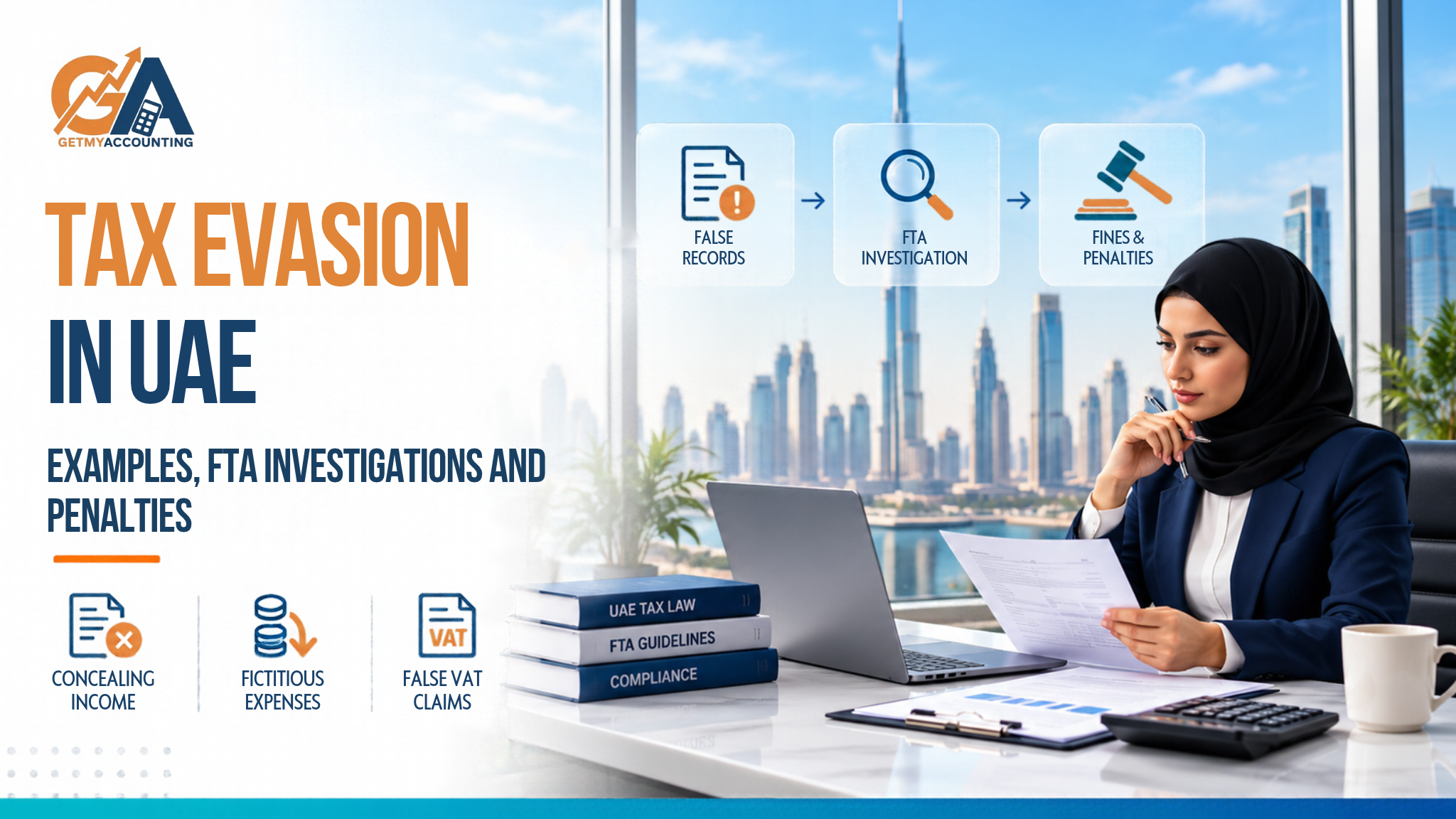
Tax Evasion in UAE: Examples, FTA Investigations and Penalties
Introduction
GetMyAccounting Editorial Team | October 2026 | 10 min read
A wrong tax figure can leave a business owner wondering whether the problem is a reporting mistake or something more serious. Understanding Tax Evasion in UAE as a topic starts with looking at what happened, why it happened and what the evidence shows.
This guide explains deliberate evasion, how suspected cases may be investigated and the possible consequences. All numerical examples are hypothetical.
Quick Answer
Tax evasion involves using illegal means to reduce tax, avoid paying it or obtain an unauthorised refund. The Federal Tax Authority (FTA) can examine records and investigate reported concerns. Proven offences can attract criminal fines, imprisonment or both. An incorrect return alone does not establish deliberate evasion.
Tax Evasion in UAE: Meaning and Legal Framework
Article 1 of the Federal Decree-Law No. 28 of 2022 on Tax Procedures defines evasion by reference to illegal means and their tax outcome. Article 25 identifies deliberate acts that can constitute an offence, including understating revenues, unlawfully collecting tax and intentionally reducing tax due.
The legal framework is primarily set out in Federal Decree-Law No. 28 of 2022 on Tax Procedures, as amended, together with its Executive Regulation and relevant tax legislation.
The important question is whether the conduct meets the relevant legal requirements. A suspicious entry requires examination; it is not a conclusion by itself.
How Is Tax Evasion Different from a Tax Error or Lawful Tax Planning?
An accidental entry and a fabricated transaction may produce similar-looking figures, but the circumstances differ. Lawful planning uses available provisions within their conditions and applicable anti-abuse rules. Deliberate evasion involves unlawful conduct. Genuine errors still need attention and can carry administrative consequences.
| Situation | Illustrative example | What needs consideration |
|---|---|---|
| Reporting error | An invoice is accidentally omitted | Cause, tax impact and correction procedure |
| Lawful tax planning | A business claims a deduction it genuinely qualifies for | Eligibility, evidence and anti-abuse rules |
| Suspected evasion | A fictitious purchase is deliberately recorded | Intent, supporting evidence and offence requirements |
Example: An accountant types AED 123,000 instead of AED 139,000. That error should be assessed and corrected appropriately. Deliberately replacing the actual sales figure to conceal revenue presents a different issue.
What Are Common Examples of Tax Evasion?
Concealing Sales or Revenue
A business deliberately leaves some transactions out of its records to reduce reported income or avoid applicable tax thresholds.
Example: A trader receives AED 60,000 from customers but intentionally excludes those sales from its accounts. The concern is the deliberate concealment, rather than whether customers paid in cash or by card.
Recording Fictitious Expenses
A company invents purchases or service charges to make its taxable profit appear lower.
Example: A business records AED 40,000 for consultancy that never took place. A document labelled “invoice” does not make a nonexistent service genuine.
Making False VAT Claims
Invented purchases can create input VAT claims that the business is not entitled to deduct.
Businesses can review their transaction records through VAT Compliance UAE support before claiming input VAT.
| VAT calculation | Genuine position | With an invented AED 5,000 input claim |
|---|---|---|
| Output VAT | AED 20,000 | AED 20,000 |
| Eligible input VAT | AED 8,000 | AED 8,000 |
| Additional false claim | None | AED 5,000 |
| Reported payable VAT | AED 12,000 | AED 7,000 |
This illustration shows an AED 5,000 understatement. It assumes the genuine input VAT is recoverable and ignores other adjustments.
Collecting Tax Without Registration
Article 25 also covers deliberately imposing and collecting amounts as tax without being registered.
For example, a business that is not VAT registered adds a charge described as VAT to customer invoices. That conduct requires examination under the applicable rules.
How Can the FTA Investigate Suspected Tax Evasion?
The FTA can conduct tax audits, review records and obtain originals or copies under Articles 16 and 17. Reports through Raqeeb provide another source of information. An audit finding, a tax assessment and a criminal conviction are distinct outcomes.
Reviewing the Evidence Behind a Return
A practical review may involve explaining how a reported number connects to the underlying transaction.
Example: A business claims a machinery purchase. Its evidence may include the purchase agreement, invoice, payment and delivery records. Missing or inconsistent evidence may need clarification; it does not automatically prove fraud.
Inspecting Business Premises
Audits generally require at least ten business days' notice. Article 16 permits entry without prior notification in specified circumstances, subject to required approvals. Temporary closure powers have conditions and time limits; permanent closure is not an automatic outcome.
Considering Reported Information
A report may identify transactions or documents that warrant investigation. Evidence must still be assessed.
Criminal proceedings under Article 26 require a written request from the FTA Director General. Criminal punishment is determined through the legal process, rather than automatically imposed by an audit notice.
Tax Evasion in UAE: What Penalties Can Apply?
The consequences of tax evasion should be understood in separate parts: outstanding tax, applicable administrative penalties and criminal punishment. Paying one does not automatically remove the others.
| Legal provision | Possible consequence |
|---|---|
| Article 25(2): specified evasion offences | Imprisonment, a fine from the evaded tax amount up to three times it, or both |
| Article 25(4): specified false-information, record and obstruction offences | Imprisonment, a fine up to AED 1 million, or both |
| Article 25(11) | Payable tax and administrative liabilities remain |
Source: Federal Decree-Law No. 28 of 2022 on Tax Procedures (FTA-published current text)
Where Article 25(4) conduct results in, facilitates or conceals evasion, Article 25(5) applies the Article 25(2) punishment.
Fine example: If the established evaded tax is AED 50,000, the Article 25(2) fine range is AED 50,000-150,000. This is the criminal fine range, not a calculation of every amount payable.
The court assesses punishment. The maximum fine and imprisonment are not automatic in every case.
Can Tax Evasion Cases Be Reconciled?
The Tax Procedures Law provides reconciliation mechanisms for certain tax-evasion crimes. Before a criminal case is initiated, the FTA may reconcile in specified circumstances subject to the applicable settlement requirements. After criminal proceedings begin, reconciliation may be available through the Public Prosecution under the conditions set by the law and Executive Regulation. Availability and financial requirements depend on the offence and stage of the proceedings. This reconciliation process does not remove the underlying obligation to settle Payable Tax and Administrative Penalties; the applicable reconciliation routes themselves require the relevant amounts to be settled.
Source: Article 27, Federal Decree-Law No. 28 of 2022 on Tax Procedures, as amended.
What Should a Business Do After Discovering a Tax Error?
Start by establishing the facts. Record the affected transactions, periods and tax impact, preserve the original evidence and assess the correct procedure. A correction should explain the issue clearly and follow the applicable rules.
A practical sequence is:
- Save the submitted return, invoices and original accounting entries.
- Record when and how the discrepancy was discovered.
- Reconcile the correct figure and identify affected periods.
- Check the applicable correction or voluntary disclosure requirements.
- Address outstanding payments and respond to FTA requests.
- Seek tax advice and legal advice where criminal concerns arise.
Errors with no tax difference still require the appropriate correction. Article 10 and its implementing rules set out how tax errors and omissions are corrected, including when a Voluntary Disclosure is required and when an error may be corrected through a tax return.
Businesses dealing with wider tax registration, filing or compliance matters can also review support from Corporate Tax Advisors in UAE.
Avoid inserting an arbitrary adjustment into a later return simply to make totals match.
Tax Evasion in UAE: How to Report Suspected Offences
The FTA's Raqeeb programme receives information about suspected tax violations and evasion. A useful report explains the observed conduct, relevant dates and available evidence. The FTA verifies the information; submitting a report does not establish guilt.
The FTA Raqeeb Whistleblower Programme User Guide (December 2024) explains the submission process.
Useful details include:
- The business or person concerned.
- The relevant transactions and dates.
- How the reporter became aware of the concern.
- Supporting documents and the reporter's relationship with the business.
Describe observations accurately and distinguish facts from assumptions. For example, an instruction to omit particular sales is more specific than a general claim that a business “must be avoiding tax.”
What Records Help a Business Explain Its Tax Position?
Organise evidence so that another person can follow a transaction from the commercial agreement to the accounts and return.
Keep relevant invoices, contracts, payment records, delivery evidence, ledgers, returns, calculation schedules and FTA correspondence. The applicable period can vary depending on the record type and circumstances, including an ongoing audit, dispute or other statutory extension.
Regular reconciliation helps identify missing transactions and unexplained differences. Where these issues recur, a structured bookkeeping and accounting process can help organise the underlying records.
Check the Commercial Story Behind Unusual Entries
Before treating an unusual transaction as a tax concern, ask what actually happened. Who supplied the goods or services? What did the business receive? When was the work completed? Does the amount in the accounts match the agreed price?
These questions are particularly useful when an invoice description is vague or a payment covers several transactions. A short written explanation can connect documents that would otherwise look unrelated.
Example: A company pays AED 18,000 in one transfer for three genuine invoices of AED 6,000 each. Comparing the payment with only one invoice creates an apparent mismatch. Listing all three invoice references explains the difference without changing the underlying records.
Keep a Clear Record of Corrections
When reviewing an entry, keep the original version and record the reason for any change. Note who reviewed it, the supporting documents and the date of the adjustment. This helps a later reviewer understand the sequence of events.
Separate unresolved questions from confirmed errors. For example, mark a missing delivery document as “awaiting supplier confirmation” rather than describing the purchase as fictitious before checking it. Assign someone to follow up and record the outcome.
These steps support a clearer review; they do not determine whether an offence occurred or replace the applicable tax correction procedure.
Conclusion
Understanding the topic of Tax Evasion in UAE helps businesses recognise when an issue needs a routine correction and when specialist advice is necessary. When a discrepancy appears, establish the facts, preserve the evidence and address it through the appropriate procedure.
Frequently Asked Questions
Can the FTA Audit a Small Business?
Yes. Article 16 permits audits of any person to verify compliance. Small business size does not by itself create immunity from an audit.
Does Appointing a Tax Agent Remove the Business's Responsibility?
No. Appointing a tax agent does not remove the person's responsibilities under Article 14. Review what happened, preserve evidence and assess the necessary correction.
Does Paying a Criminal Fine Settle the Unpaid Tax?
No. Article 25(11) preserves the obligation to settle payable tax and administrative penalties.
Can Correcting an Error Guarantee That No Penalty Will Apply?
No. The outcome depends on the applicable provisions, timing and circumstances. Correction is not a guaranteed waiver or automatic protection from criminal liability.
What is the punishment for tax evasion in the UAE?
Under Article 25(2) of the Tax Procedures Law, specified tax evasion offences can result in imprisonment, a criminal fine ranging from one to three times the evaded tax, or both. Outstanding tax and applicable administrative penalties remain payable. The court determines the punishment based on the offence and circumstances.
Disclaimer: This article provides general information, not case-specific legal or tax advice. The FTA-hosted English law is labelled an unofficial translation; the authoritative Arabic legislation prevails. Examples are hypothetical and do not describe proven offences by any named business.
Written by: GetMyAccounting Editorial Team
Reviewed by: Vipul Gupta, Accounting & Tax Consultant
Last updated: October 2026